

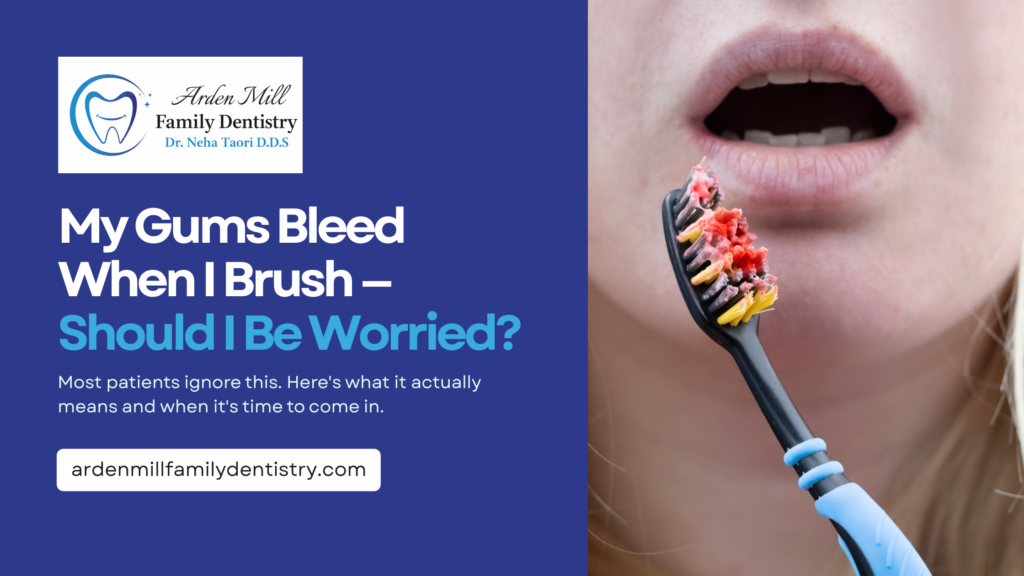
If your gums bleed a little when you brush, you’ve probably told yourself it’s no big deal. Maybe you brushed too hard. Maybe it’s just sensitive. It’ll go away on its own.
Most people think this. Most people are wrong.
Bleeding gums are your mouth’s way of telling you something is off — and the earlier you pay attention, the easier it is to fix. At Arden Mill Family Dentistry in Fort Mill, SC, we see this more than almost any other concern patients bring up. And the good news is: if you catch it early, it’s very manageable.
Here’s what bleeding gums actually mean, when to worry, and what to do next.
Why Do Gums Bleed When You Brush?
The most common reason is gingivitis — the earliest stage of gum disease. When plaque builds up along the gumline and isn’t fully removed through brushing and flossing, your gums get inflamed. Inflamed gums bleed easily, especially when you brush or floss.
Other reasons your gums might be bleeding:
- You haven’t flossed in a while and just started again
- Your toothbrush bristles are too hard
- You’re brushing with too much force
- Hormonal changes (pregnancy, puberty, or menopause can affect gum sensitivity)
- Certain medications that thin the blood
- Vitamin C or K deficiency
- Stress affecting your immune response
A one-time bleed from brushing too aggressively isn’t necessarily a red flag. But if your gums bleed regularly — even a little — that’s worth taking seriously.
What Is Gingivitis and How Did I Get It?
Gingivitis is inflammation of the gum tissue, and it’s extremely common. In fact, most adults will experience it at some point in their lives. It’s caused by the bacteria in plaque that builds up along and below your gumline.
The tricky part is that gingivitis often has no pain. You may not even realize you have it until you notice bleeding, swelling, or gums that look slightly darker or puffier than usual.
Left untreated, gingivitis can progress into periodontitis — a more serious form of gum disease where the infection spreads below the gumline and starts affecting the bone and tissue that hold your teeth in place. That’s a much bigger problem to fix.
The timeline from gingivitis to periodontitis varies from person to person, but the earlier you catch it, the better.
Signs That Something More Serious May Be Going On
Regular bleeding when you brush is a signal. But watch out for these additional signs that things may have moved beyond early-stage gum irritation:
- Gums that bleed during eating, not just brushing
- Gums that look red, swollen, or feel tender
- Gums that are pulling away from your teeth (gum recession)
- Persistent bad breath that doesn’t go away with brushing
- Loose teeth or teeth that feel slightly shifted
- Pain or discomfort when chewing
If you’re experiencing any of these, please don’t wait. These are signs that your gum health needs professional attention — not just better brushing habits.
What Happens If You Ignore It?
This is the part people don’t fully understand.
Gum disease doesn’t stay in your mouth. Research has consistently linked untreated periodontal disease to increased risk of:
- Heart disease and cardiovascular issues
- Diabetes complications
- Preterm birth and low birth weight
- Respiratory infections
- Stroke
Your mouth is connected to the rest of your body in ways that genuinely matter. Bacteria from infected gum tissue can enter the bloodstream and affect your overall health. This is why dentists talk about gum health so much — it’s not just about your teeth.
Beyond systemic health, ignoring bleeding gums can lead to gum recession, bone loss, and eventually tooth loss. These are expensive, complicated problems to fix compared to the relatively simple treatment for early gum disease.
Small issue now. Big issue later. Don’t let it get there.
What Can You Do Right Now?
At home:
- Brush twice a day using a soft-bristled toothbrush — no aggressive scrubbing
- Floss once a day, gently and consistently (yes, even if it bleeds at first — it usually stops once your gums get healthier)
- Use an antiseptic mouthwash to reduce bacteria
- Stay hydrated — dry mouth makes everything worse
- Don’t smoke. Smoking significantly worsens gum disease and masks symptoms
At the dentist:
Come in for a professional cleaning and exam. This is the most important step. No amount of brushing at home removes tartar that’s already hardened below the gumline — that requires professional tools.
At Arden Mill Family Dentistry in Fort Mill, SC, we do a full periodontal evaluation as part of your routine exam. If there are signs of gum disease, we’ll tell you clearly what we’re seeing, what stage it’s at, and exactly what your options are. Nothing vague. No unnecessary alarm.
If it’s caught early, a professional cleaning and improved home care is often all it takes. If it’s more advanced, we offer periodontal disease treatment to address what’s happening below the surface.
How Often Should You Come In?
Most patients do well with two cleanings per year. If you have a history of gum disease or are currently dealing with bleeding gums, your dentist may recommend more frequent visits — typically every 3 to 4 months — until things stabilize.
The goal is to stay ahead of the problem, not chase it.
When Should You Book an Appointment?
If your gums have been bleeding on and off for more than two weeks, book an appointment. Don’t wait until there’s pain — with gum disease, pain often arrives late, after real damage has already been done.
If you’re in Fort Mill, SC or the surrounding area, Arden Mill Family Dentistry is accepting new patients and would be happy to take a look. We’re open Monday through Friday 8:30 AM – 5:00 PM and Saturdays 9:00 AM – 2:00 PM.
New patients: ask about our Cleaning, Exam & X-Ray offer when you call or book online.
📞 803-650-6424 📍 5527 Arden Mill Dr #105, Fort Mill, SC 29715
The Bottom Line
Bleeding gums are common. They are not normal.
Most of the time, it means your gums are inflamed and need attention. Caught early, it’s one of the most straightforward dental issues to treat. Left alone, it can quietly cause serious damage — to your teeth, your gums, and your overall health.
If you’ve been putting this off, March is as good a time as any to stop. Book a visit with us at Arden Mill Family Dentistry in Fort Mill, SC and let’s take a look together.